

REGISTRATION TIPS
Tutorial Videos:
Tips For Registering Your Appaloosa
Remember, registering “colored,” solid and non-characteristic Appaloosas is equally important. If you don’t plan on breeding, racing or showing your foal, its next owner may wish to have that option open. In addition, there’s no reason to delay registration of a non-characteristic (N) foal, anticipating it will develop characteristics. Once the foal is registered with a (N) Certificate of Registration, the owner may apply for advancement to Regular Registration for up to one year from the date the original certificate was issued – free of charge. Also, Appaloosas with (N) Certificates of Registration have the option to apply for a Performance Permit for race or show purposes. If your foal isn’t registered, its breeding and parentage may be forgotten, its value decreased, and certain opportunities may be lost forever.
Taking the frustration out of registration
What we see is what you get
Required photographs
- Front view: This photograph must include the whole head, ears, front legs and hooves. If the horse has a face marking or lower lip snip, it’s important it show in the photograph.
- Rear view: This photograph must show the complete rear of the horse including legs and hooves. Often a horse will have a heel mark on the back of a leg that won’t be noted on the Certificate of Registration because of inadequate photographs.
- Right view: This photograph must include the complete right side of the horse, including the head, ears, legs and hooves. It’s important that the horse not be standing square – the horse’s outside legs may hide the inside legs.
- Left view: This photograph must include the whole left side of the horse, including the head, ears, legs and hooves. Again, the horse shouldn’t be standing square.
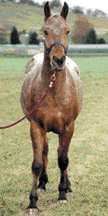
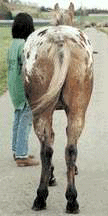
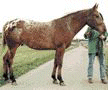
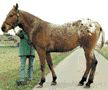
The four required photographs must show all of the horse, including its legs and hooves, from each view. All of the horse’s head and ears, as well as legs and hooves should show in the front view.
Characteristics
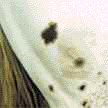
- Mottled skin: Mottled skin is different from pink (flesh-colored or non-pigmented skin), in that it will normally contain small, round, dark spots (pigmented skin) within its area. If a horse has mottled skin it’s most likely to be found on the anus, vulva, udderor sheath. (It isn’t found on the penis.) This means that a person will have to lift the tail of the horse in order to take a photograph showing mottled skin on the anus or vulva. You may have to kneel beside or under the horse in order to get a clear photograph of mottled skin on the udderor sheath. This can be tricky and dangerous – be careful not to get kicked!
Many breeds of horses have specks of flesh colored skin in these regions, and this shouldn’t be confused with mottled skin. Many Appaloosas have varying amounts of mottled skin on their muzzle, extending over one or both nostrils and around the upper and lower lips. All horses have a line on the lips caused by the contrast of pigmented and non-pigmented skin. Therefore, you shouldn’t separate the lips for signs of mottled skin.
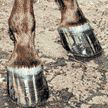
- Striped hooves: Some Appaloosas have bold and clearly defined vertical light and dark stripes on the hooves. But because many breeds of horses have striped hooves on legs with white leg markings, the stripes aren’t considered an Appaloosa breed characteristic unless visible in the absence of white leg markings.
- White sclera: A horse is said to have white sclera when there’s white area encircling the dark or pigmented iris of the eye. It should be easily seen when the horse is in a relaxed state. White sclera may be considered an Appaloosa characteristic when it’s not in combination with a bald face. If your horse has a bald face, the registrar may discount the white sclera.
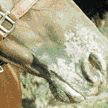
Always submit photographs of your horse’s Appaloosa characteristics. This horse displays mottled skin. Mottled skin is different from non-pigmented skin in that it contains small dark spots.
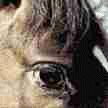
In addition to mottled skin, this horse also displays white sclera in the eye.
The correct form
Stallion owners without web access can request blank Registration/Breeder’s Certificate Applications by contacting the ApHC Customer Service Department at (405)400-9296, ext. 300. Current forms will be sent to you free of charge. Blank Registration/Breeder’s Certificate Applications can also be printed from the downloadable forms section of the ApHC website.
Please contact the ApHC Customer Service Department at (405)400-9296, ext. 300, if you have questions.
Section A: Foal Name Selection
Foal Name Q & A
Naming your foal is an important part of the registration process. It’s also one of the more common causes of delay in receiving your foal’s Certificate of Registration.
The name choices submitted can’t consist of more than 24 letters and spaces. Numbers, symbols, special characters and punctuation can’t be used in name choices, and they can’t end in “filly” or “colt.” Names of famous horses or famous people can’t be used, unless the ApHC receives notarized consent from the famous person. A name that’s identical, or sounds like one currently in use is unacceptable. For example: He’s A Prince, Heza Prince, and He Is A Prince are all considered the same name because they sound alike.
In cases where the name choices submitted can’t be used, there will be a delay in registration while we contact you for new name choices. In order to avoid this delay, you may authorize the ApHC to name your horse by checking the appropriate box on the registration application. We’ll attempt to choose a name you’ll like, by using the name choices you submitted and the pedigree as a guide.
Section B: Foal Information
When completing the information regarding the foal’s sire and dam, if you’re not using an ApHC pre-printed registration application, print the name and registration number clearly. In the blanks marked “Breed,” indicate the registry that horse belongs to. At least one of your foal’s parents must be an ApHC registered Appaloosa with Regular (#) classification. The other parent may be registered with the ApHC, American Quarter Horse Association, Arabian Horse Association, or Jockey Club. See Official Handbook of the ApHC for all requirements and rules. ApHC registered stallions and mares classified as N, CN, BT, B#, ID, PC, I#, or IN, must be bred to an Appaloosa with Regular (#) classification in order for the resulting foal to be eligible for ApHC registration.
Section C: Breeder's Certificate
Section D: Foal Identification
Section E: Registration Fee Schedule
Foal Date to 6th month foal date
7th month to after 12th month foal date
13th month to 24th month foal date
25th month and there after
Members
$50
$85
$135
$170
If the shortest possible processing time is a requirement, the ApHC offers the following RUSH fees.
- To have your work completed in 10 working days, the cost is an additional $75 per application for members.
- To have your work completed in 48 hours, the cost is an additional $150 per application for members.
Membership Application
Memberships
Lifetime: This membership is valid for the life of the person. It includes a permanent gold membership card, an honorary lifetime member jacket, one year complimentary subscription to Appaloosa Journal, a waiver of ten-day RUSH fees for registrations and transfers if the outside of the envelope is marked RUSH, free ApHC fax services, complimentary entry into all ApHC socials, and the benefits of a regular individual membership. These include voting rights, reduced rates on various club services and the eligibility to apply for a low-interest rate ApHC Visa. The total cost is $700.
Individual: This membership is for one person, excluding companies, businesses ranches, and farms. It includes all privileges of ApHC membership, including voting rights and a reduced rate on various club services. An individual membership includes issues of Appaloosa Journal. The total cost is $75.
Family: This membership includes the head of household, spouse and children (if any) under the age of 18 years as of January 1 of current year. Each individual over the age of 18 years is considered a member with all privileges of individual membership. Each member will be issued a membership number. Children in this type of membership are given an ApHC youth membership with all privileges of youth membership. This membership includes issues of Appaloosa Journal. The total cost is $140.
Youth: The ApHC youth membership (AYA) applies to applicants 18 years of age or younger as of January 1 of current year. Date of birth and parent or legal guardian signature is required. Married or divorced individuals are ineligible for a youth membership. This is a non-voting membership, and it doesn’t include issues of Appaloosa Journal. The total cost is $25.
One-time youth: This is a great option for those individuals under the age of 18 as of January 1 of the current year, who want to avoid having to renew each year. This membership is valid through the year the applicant is 18 or under as of January 1. Date of birth and parent or legal guardian signature are required. All youth membership privileges apply. This is a non-voting membership, and it doesn’t include issues of Appaloosa Journal. The total cost is $150. Apply today and receive a one-time youth cap!
Section F: PERFORMANCE PERMIT
A. Application requirements for registered Appaloosa horses for which a Performance Permit is sought are as follows:
- To be eligible to apply for a Performance Permit, the horse must be registered with the ApHC in the non-characteristic (N) category.
- The owner is required to submit to the ApHC, the original Certificate of Registration, along with a properly completed and signed Performance Permit application, four current photographs of the horse including both sides, a direct face and rear view, and proper Performance Permit fees in accordance with the applicable fee schedule.
B. Application requirements for horses pending registration for which a Performance Permit is sought are as follows:
- A Performance Permit may be applied for upon initial application for registration of a horse.
- The owner of the horse should have good reason to expect the horse would receive a non-characteristic (N) classification when registered.
- Along with the requirements for registration, the owner must submit a properly completed and signed Performance Permit application and the proper Performance Permit fee in accordance with the applicable fee schedule.
C. Non-characteristic (N) horses will be issued a Performance Permit if they meet the following requirements:
- Any horse for which a Performance Permit is sought must be DNA tested by an ApHC approved laboratory and the results filed with the ApHC.
- The dam of any horse for which a Performance Permit is sought must be DNA tested by an ApHC approved laboratory and the results filed with the ApHC.
- The sire of any horse for which a Performance Permit is sought must be DNA tested by an ApHC approved laboratory and the results filed with the ApHC.
Performance Permit Fees: Member
Foal date to 24th months –
Appaloosa x Appaloosa $75
Appaloosa x Approved Outcross $150
25 months and older –
Appaloosa x Appaloosa $100
Appaloosa x Approved Outcross $250
For complete rules and regulations regarding Performance Permits,
see the Official Handbook of the ApHC or visit, www.appaloosa.com
Section G: GENETIC TEST KITS
Section H: Checklist - Did you remember:
Completing a registration application is no small task. An accurate form will eliminate unnecessary delays in processing, and assures you the benefits of proper identification and registration of your horse. If you have any questions or are unsure how to complete a portion of your application, an ApHC customer service representative will be happy to assist you. Call us at (405)400-9296 ext. 300.
Section I: Credit Card Charges:
This section is provided for customers wishing to pay fees with Visa, Discover, MasterCard, or American Express. The ApHC does not accept American Express. It’s important that you include all of the raised numbers on your credit card in the space provided. The ApHC also must have an expiration date. 3-digit security code (from back of card) and the cardholder’s name, address, phone number and signature. If information is incomplete or incorrect, it will cause a delay in the processing of your registration application.
Starting January 1, 2019 Appaloosa Horse Club will implement a credit card surcharge.
Information to help make sure your registration application sails smoothly through the registration process by following these simple guidelines:
- Photos must be printed on photo quality paper. For quality insurance, we strongly suggest you have them printed at a print shop instead of printing them on a home printer. Photographs are not accepted by e-mail or copies on regular copy paper.
- Photographs must be on photo quality paper and not larger than 4×6 inches (10.2 cm x 15.2 cm).
- Photos should be sharp and clear.
- Please verify that the horse’s markings are all identifiable.
- Include close-ups of all Appaloosa characteristics.
- Include close-ups of small markings such as snips or heel marks.
- Include photos of brands or scars. The whole horse must be visible in the photos, including the ears, hooves, and tail. Don’t cut off your horses head when cropping photos!
2. Name choices:
Provide three options. Do not exceed 24 letters and spaces. Punctuation, special characters, numbers, or Roman numerals are not allowed.
Please refer to the Official Handbook of the ApHC for all rules and requirements for ApHC registration or contact the ApHC Registration Dept. at (405)400-9296, ext. 300. Applications can be printed from the downloadable forms section of the ApHC website.